
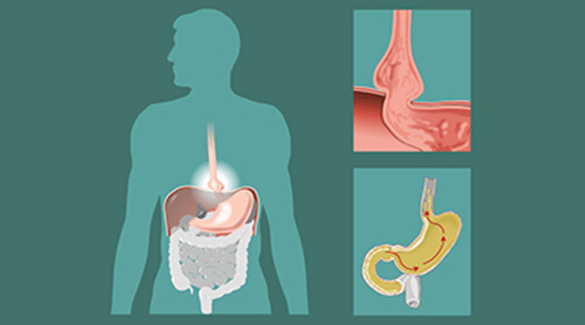
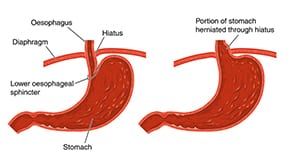
A hiatal hernia develops when a portion of your stomach migrates upward through your diaphragm, and may require hiatal hernia repair. Your diaphragm is a large, dome-shaped muscle that separates the chest cavity and abdomen and has a small opening called the hiatus.
- The hiatus is where your food tube (esophagus) passes to connect to your stomach
- If the muscles surrounding the hiatus become weak, the upper portion of your stomach can push up through the diaphragm and into your chest cavity
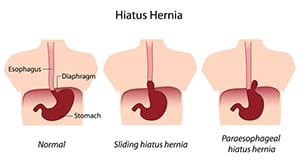 Physicians might recommend surgical repair in patients who have a paraesophageal hernia, as a high percentage of these patients develop a strangulated hernia. This is a serious condition and can result in the puncture or tearing of the digestive tract and may be fatal. To prevent this, a hiatal hernia repair is performed. Other reasons this procedure may be recommended include:
 Traditionally, surgeons have performed a hiatal hernia repair via an open surgery, which requires a larger incision to the abdomen or chest wall area. This more invasive approach is associated with a greater risk for complications, increased pain and risk for infection, and a much longer recovery time. Surgeons are now more prone to use a laparoscopic approach, which is minimally invasive, and results in decreased pain, complications, and scarring, as well as a quicker recovery.
 You may awaken with a nasogastric tube, a tube placed into your stomach through your nose to help drain fluids and air from your stomach. This is typically removed the next morning. The typical hospital stay is one to three days.
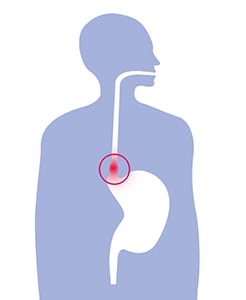 Paraesophageal hiatal hernias may become trapped in the chest and unable to migrate back down to your abdomen. This is called strangulation and the blood supply could potentially be cut off to your hernia. The strangulated parts of your hernia may begin to die from not receiving adequate oxygen supplied by your blood. Should this condition occur, you will notice a sudden, sharp pain in your chest. You may also have difficulty swallowing. Immediate medical attention should be sought in this urgent medical situation.